Since its establishment in 1965, the U.S. Department of Housing and Urban Development (HUD) is perhaps most recognized for providing affordable housing through its many grant programs. HUD was formed on the premise that “stable housing uplifts all of society,” resulting from the evolution and consolidation of several housing-related federal agencies created by Congress, dating back to the 1930s. However, there may be less familiarity with the community development activities various HUD grants support through the funding of infrastructure improvements, public facilities and services, economic development efforts, and disaster relief projects. Investment in these facilities and resources is essential for creating safe, healthy, accessible, and resilient communities.
Community Development Block Grants
The Community Development Block Grant (CDBG) Program was enacted by President Ford in 1974 and is one of HUD’s longest-running programs. The CDBG Program’s flexibility assists communities with local budget pressures and helps fill financing gaps for critical public facilities, services, infrastructure (e.g., street and utility repairs and improvements), and economic development as well as housing that will benefit an area having a large number of low- and moderate-income residents. The main CDBG Program is generally divided into “entitlement” and “non-entitlement” categories. Entitlement areas are larger cities and urban counties that receive annual grant funding directly from HUD based on formula thresholds. Non-entitlement areas are smaller cities and counties that receive grant funding administered from their respective states. Local governments, as CDBG grantees, may then utilize the funds directly for public projects or distribute funds to private or nonprofit developers to execute projects within their community.
Since its inception, the overall CDBG program has evolved to include several sub-programs. The CDBG Disaster Recovery (CDBG-DR) program was initiated by HUD in 1992, primarily in response to Hurricane Andrew. CDBG-DR funding may be appropriated by Congress following Presidentially declared disasters to assist cities, counties, and/or states with disaster relief, long-term recovery, restoration of public infrastructure, and economic revitalization, as well as repair of damaged housing. Like the main CDBG program, CDBG-DR benefits low- and moderate-income residents, particularly those impacted by disasters in distressed environments. Similar to CDBG-DR, the CDBG-Mitigation (CDBG-MIT) program, authorized in 2018, is a one-time supplement awarded for disaster recovery and resiliency efforts. However, where CDBG-DR is focused on rebuilding from the impacts of a specific disaster, CDBG-MIT focuses on prevention against future risks.
Community Project Funding
Community Project Funding (CPF) is an Economic Development Initiative Special Purpose grant in which members of Congress direct spending for specific projects in their districts. Applications are made to congressional members, who advise HUD of the selected CPF grantees and the grant amounts, which are paid through HUD’s annual budget. HUD then administers and processes the CPF grants for the congressional members. Unlike CDBG, CDBG-DR, and CDBG-MIT funds, CPF grants can be awarded directly to individuals, businesses, nonprofits/organizations or other non-governmental entities, as well as to state and local governments. In addition to housing and homelessness prevention, CPF funds can be appropriated for public facilities and services, infrastructure, parks, and resilience planning.
Costs Covered by Grant Awards
The various CDBG program and CPF grant funds can be applied toward both “hard cost” expenses necessary for the physical construction, renovation, or improvement of a property, and project-related “soft costs” which may include due diligence studies (e.g., Phase I/II Environmental Site Assessments) and environmental surveys (e.g., architectural/archaeological, threatened and endangered species, and wetland delineation/confirmation) required for a project’s NEPA compliance; architectural and engineering design; and local permits and fees (e.g., building permits, rezonings) for a project.
Some recent examples of non-housing community development and disaster recovery/mitigation projects Timmons Group has completed include the following:
- Underground tunnel – CPF funding to construct a tunnel 150 feet underground, 18 feet in diameter, and 1 mile in length, with associated diversion structures and drop shafts, to intercept and divert storm water underground to a nearby river to reduce flash flooding risk.
- Water Main Replacement – CPF funding to construct approximately 1.5 miles of 20-inch ductile iron water main to replace an existing 20-inch asbestos cement water main that has exceeded its useful life and is experiencing repeated system failures requiring costly repairs.
- Flood Gate – CDBG-MIT funding to construct a permanent, mechanically powered flood gate system to prevent future flood occurrences primarily associated with hurricanes.
- The Y Building Renovations – CPF funding for ADA-accessibility improvements to interior facilities including six bathrooms, a pool area, and locker rooms.
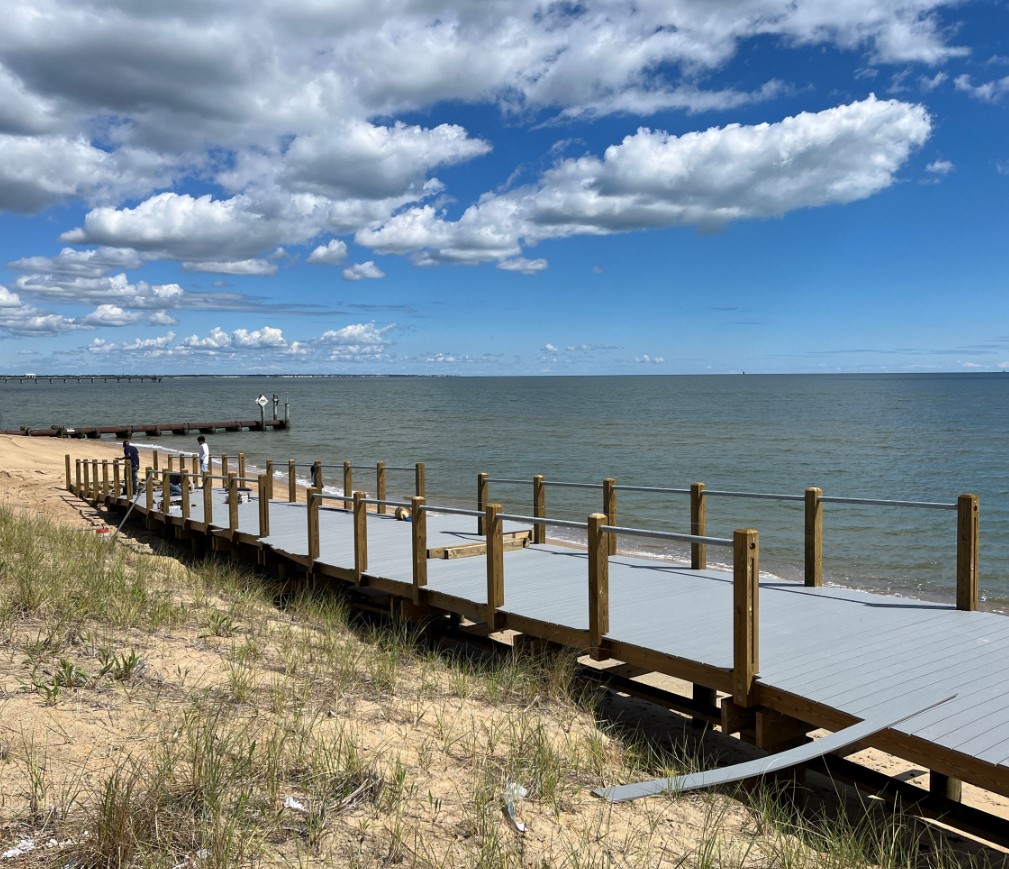
- Beach Park Renovations – CDBG funding for dune restoration, a pedestrian walkway extension for ADA-accessible beach access, and a park expansion.
- Public Health/Services Building Renovation – CPF grant for the renovation of a soup kitchen, health center, permanent supportive housing, and ADA-accessibility sidewalk modifications.
- Wastewater Collection System – CPF grant to design and construct over 3 miles of 12-inch sanitary sewer force main and two pump stations within a publicly owned industrial/manufacturing site which will provide an economic benefit to the region.
- Public Safety Training Center – CPF grant for the design and construction of several facilities to provide training for future law enforcement, emergency medical personnel, and firefighters.
- Mountain Biking Trails Development – CPF grant for the planning, design, and construction of a 25-mile, natural surface, multi-use, mountain bike-optimized trail network that will link a nearby town to a future resort property and serve as an economic generator for the local community.
- Park Improvements – CDBG funding for general park and playground improvements to several neighborhood parks.
- Connector Sidewalk – CDBG funding for a 1,500-foot sidewalk connection.
As HUD continues to provide financial support for affordable housing, the CDBG and CPF grant programs also serve as financial resources that support vital non-housing community development needs. CDBG and CPF grants, through public-private collaboration, help alleviate financing barriers to the development of essential public facilities and services, infrastructure repairs and improvements, economic development projects, and disaster relief efforts. Financial support from CDBG or CPF for these community assets can provide the means to help improve neighborhoods, expand economic opportunities, and increase area resiliency.