Public agencies are under increasing pressure to deliver more infrastructure improvements amid limited funding, tighter schedules, increasingly complex project requirements, and growing public expectations. Environmental requirements, utility coordination, right-of-way challenges, stakeholder involvement, and aging infrastructure can all add uncertainty to project delivery.
These challenges are prompting agencies to consider alternative delivery methods such as Progressive Design-Build (PDB) and Public-Private Partnerships (P3). While both approaches can help address project complexity and risk, they serve different purposes. The key is selecting the approach that best aligns with the project’s goals, constraints, and available resources.

Progressive Design-Build vs. Public-Private Partnership
The simplest distinction is that Progressive Design-Build is primarily a project delivery method, while a Public-Private Partnership (P3) can encompass both project delivery and financing, as well as long-term operations and maintenance.
With Progressive Design-Build, the owner engages the designer and contractor early in the process. The team works collaboratively during the design phase to evaluate risks, improve constructability, refine the project scope, and develop a better understanding of cost and schedule before construction begins. This can be particularly valuable for projects with significant uncertainty, complicated construction sequencing, utility coordination, environmental considerations, or other challenges that benefit from early contractor involvement.
In comparison, a P3 creates a long-term contractual agreement between a public agency and a private partner. In addition to design and construction, the private partner may also assume responsibility for some combination of financing, operations, and maintenance services. This allows agencies to leverage private-sector expertise and potentially transfer certain risks while focusing on long-term project performance. Examples of P3 structures include Design-Build-Operate-Maintain (DBOM) and Design-Build-Finance-Operate-Maintain (DBFOM).
Because of their complexity and potential financing requirements, P3s are generally associated with large infrastructure investments where risk allocation, funding, and long-term asset performance are significant considerations. Examples may include major transportation facilities, bridges, tunnels, transit systems, airports, and large water or wastewater infrastructure projects.
What Should Owners Consider?
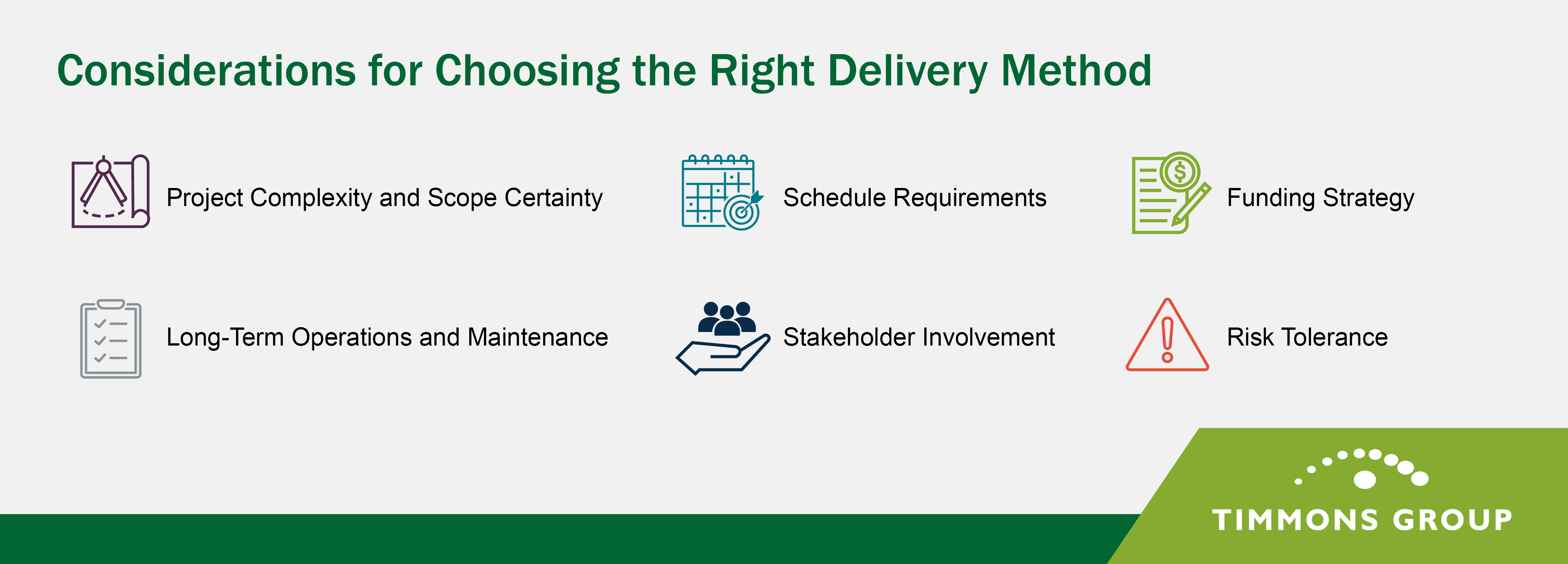
Selecting the right delivery method starts with defining what success looks like for the project. Owners should consider project complexity and scope certainty, schedule requirements, funding strategy, risk tolerance, stakeholder involvement, long-term operations and maintenance, and their internal resources and capabilities.
Not every project benefits from the same level of private-sector involvement or risk transfer. A project with an evolving scope and significant technical uncertainty may benefit from the collaborative nature of Progressive-Design Build. Meanwhile, a major infrastructure investment requiring financing and long-term performance commitments may warrant consideration of a P3.
Another important factor is the full lifecycle of the project. Owners should think beyond design and construction and evaluate their own capacity for long-term operations, maintenance, and asset performance.
Understanding the Trade-offs
Progressive Design-Build provides greater flexibility during design and gives contractors an opportunity to help identify challenges before construction begins. In return, owners need to remain actively involved and make timely decisions throughout the process.
P3s can provide access to private financing, transfer certain risks, and establish long-term performance accountability. However, FWHA notes that P3 financing must ultimately be repaid through a funding stream such as toll revenue or public availability payments, and that private financing can carry higher costs than traditional public borrowing. P3 procurements are also typically more complex and require clearly defined expectations and performance requirements.
The key is understanding what outcomes matter most for the project and whether the benefits justify the responsibilities and costs associated with that approach.
Common Mistakes to Avoid
One of the most common mistakes agencies make is selecting a delivery method because it worked well for another project. Every project has different risks, constraints, stakeholder expectations, and objectives, and an approach that created value in one situation may not produce the same results on another.
Another is not involving key stakeholders early enough in the decision process. Technical staff, project managers, financial advisors, legal teams, and other key stakeholders should be involved early to help evaluate how each delivery method affects cost, schedule, risk, and long-term owner responsibility.
Agencies should also avoid underestimating the preparation required for alternative delivery methods. Successful implementation depends on clear objectives, strong procurement documents, effective communication, and thoughtful risk allocation.
P3 in Practice: I-66 Outside the Beltway

The Transformation of I-66 Outside the Beltway Project, delivered by the Virginia Department of Transportation (VDOT), demonstrates how a P3 can support delivery of a major infrastructure investment. The project was delivered through a partnership between VDOT, the Department of Rail and Public Transportation, and private partner I-66 Express Mobility Partners.
While working on this project as the, I had the opportunity to work closely with the general contractor, FAM Construction, and see firsthand how the P3 approach influenced the way the project was planned, coordinated, and delivered.
The scale of the project required significant coordination among the owner, designers, contractors, stakeholders, and the traveling public. According to VDOT, the partnership delivered $3.7 billion in transportation improvements along 22.5 miles of I-66, including new express lanes, interchange improvements, transit enhancements, park-and-ride facilities, and bicycle pedestrian infrastructure.
Because the private partner had responsibilities that extended beyond construction, project decisions also had to account for long-term operations and performance. This alignment encouraged the team to consider not only how the project would be built, but how it would function and serve the public for years to come.
For a project of this scale and complexity, the delivery method helped establish how responsibilities were shared, risks were managed, and decisions were made throughout the project lifecycle.
Choosing the Right Approach
Selecting a delivery method is one of the earliest strategic decisions an owner can make. It establishes the framework for allocating risks, making decisions, defining responsibilities, and determining how the project team will work together.
There is no universally “best” delivery method. Successful projects are built on early planning, open communication, and alignment among all stakeholders. When owners take the time to evaluate their options and select a delivery method that meets their needs, they create the best opportunity to deliver successful infrastructure improvements for their communities.
Ultimately, the delivery method is about creating the right environment for the team to solve problems, manage risk, and deliver lasting value.