The threat of natural disasters, particularly flooding, and the concept of building more resilient communities have recently gained significant support in the Commonwealth of Virginia. For Virginia’s municipalities, the immediate opportunity is to translate state resilience priorities into locally adopted plans, fundable projects, and policies that reduce flood risk over time.
According to the Resilience Report 2025, produced by the U.S. Chamber of Commerce, Allstate, and the U.S. Chamber of Commerce Foundation, for every dollar spent on resilience efforts, communities can save an average of $23 in future losses; with some studies climbing as high as $30. Common consensus is that it is wise to prepare for future disasters.
Successful resilience planning requires an integrated approach. At the federal level, the National Resilience Guidance published by FEMA in August of 2024, stresses the importance of a “multi-pronged approach and dedicated effort across the whole community,” by defining seven governing foundational principles for a more resilient nation:
- Focus on the Threats & Hazards that represent the greatest risks.
- Ensure resilience goals are Human Centered.
- Propose strategies and solutions that are Equitable and Just and consider the needs of historically underserved and marginalized populations.
- Apply Adaptive thinking to take advantage of evolving circumstances.
- Utilize a Collaborative approach that engages multiple sectors in a data-driven and transparent process.
- Identify Sustainable & Durable solutions to address current and future needs.
- Acknowledge the complexity of Interdependent systems and seek resilient solutions that address hazards and risks while delivering multiple benefits.
At the state level, this integrated approach is further modeled by the establishment of the Virginia Office of Resilience (VOR) in 2024, which operates under the Secretary of Natural and Historic Resources of Virginia. The role of Chief Resilience Officer was authorized in 2024 by HB1458, with the primary function being to coordinate efforts at the state level to carry out the VOR’s vision and mission:
“Vision: A prepared Virginia that adapts to and thrives in an environment of evolving hazards to the benefit of all.
Mission: We prepare, support, and protect Virginians by ensuring an integrated partnership approach to address evolving hazards across the Commonwealth.”
To promote cooperation between state, federal, and local entities, the VOR leads the Interagency Resilience Management Team (IRMT), which convenes quarterly. Together with the VOR, the IRMT has identified 73 hazards organized into 13 categories. The team has further focused resilience efforts at the state level by identifying four (4) priority areas: flooding, the water system (including water supply, treatment, and distribution), the energy grid, and public health.
According to the Virginia Office of Resilience’s website, “VOR’s goal is to provide ‘safer homes, drier roads, and stronger communities’ for all Virginians.”
Fortunately for Virginia’s Towns and Cities, the state has a head start on progress toward VOR’s goals, especially in the context of flood resilience, with the establishment of the Community Flood Preparedness Fund (CFPF) in 2020. The state’s investment in flood resilience efforts comes at a critical time as the future of federal funding and investment is uncertain. Programs such as the Building Resilient Infrastructure and Communities (BRIC) grant administered by FEMA, the Promoting Resilient Operations for Transformative, Efficient, and Cost-saving Transportation (PROTECT) grant administered by the US Department of Transportation, and others had gained traction in recent years but are now in jeopardy.
Administered by the Department of Conservation and Recreation (DCR), the CFPF Program has expanded substantially since the first awards in 2021, from initially funding 19 applications totaling $7,796,040 in Round 1, to over $315 million awarded through Round 6. Round 7 is expected to open on December 1, 2026, with applications due in early 2027. The fund supports local governments and tribes in planning and implementing flood‑prevention and resilience projects through capacity building and planning, studies, and projects. Key priorities for the Community Flood Preparedness Fund include efforts that benefit the entire community, are nature-based, and align with local, regional, and/or statewide Resilience Plans. To be considered for project funding, an applicant must have an official, adopted Resilience Plan approved by the Virginia Department of Conservation and Recreation within the last five years.
Key Strategies for Tapping into State Resources
There are a few action items that your community can take to benefit from the state’s investment in resilience, summarized below.
Understand the CFPF Program Priorities
A closer look at recently awarded CFPF grants can provide valuable insight for Virginia’s municipalities to better position themselves for funding support. The following is a breakdown of Round 6 CFPF Awards:
- Capacity Building & Planning – A total of $11.3M was awarded for capacity building and planning. Nearly two-thirds of the 25 awards support the development of Resilience Plans, encouraging municipalities to follow a systematic approach to identify resilience projects aligned with the CFPF program’s priorities. Notably, the majority of funding (over 50%) for capacity building and planning went to one-fourth of the applicants for technology solutions to develop tools to manage and utilize flood-related data for informed decision-making. The remainder of the funding was allocated to staff training and/or new positions such as hiring floodplain managers.
- Studies – A total of $8.5M was awarded to 15 Towns, Cities, and Counties, and the Hampton Roads Planning District Commission. Most study scopes include conducting stormwater inventories, hydrologic and hydraulic analyses, and watershed modeling to study and reduce flood risk.
- Projects – A total of $29M, ranging in size from $178,000 to $6.3M, was awarded to 13 projects, funding the design and/or construction of drainage improvements, living shorelines, integrated green/grey systems, dam removal and rehabilitation, enhanced stormwater storage to alleviate flooding, and more.
Align with State Planning Efforts
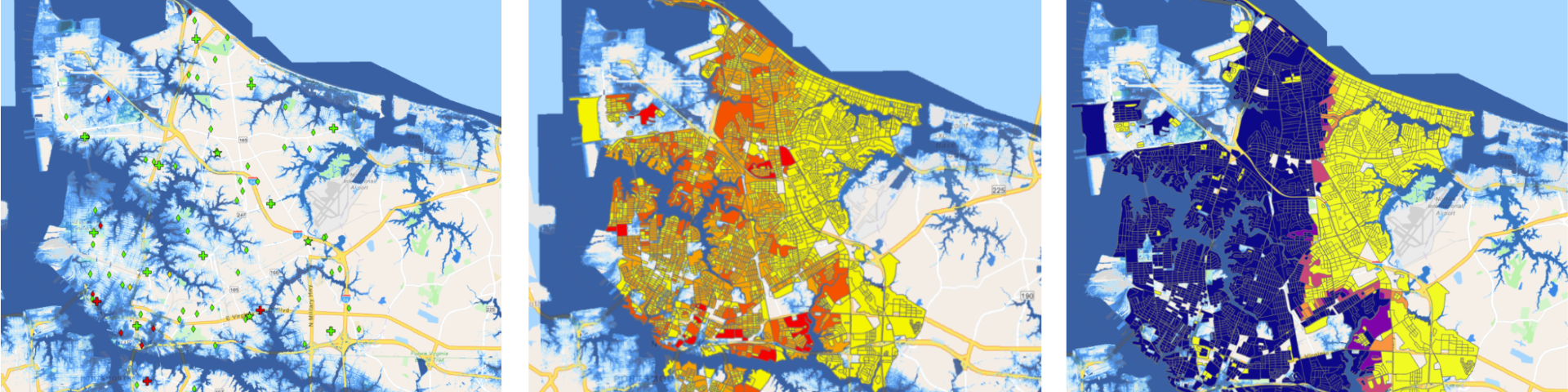
- The Coastal Resilience Master Plan (CRMP):The CRMP is a multi-phased effort focused on developing a “comprehensive path toward long-term resilience to protect people, homes, businesses, infrastructure, and ecosystems from the impacts of coastal flooding.” The state’s coastal communities are home to 70% of the state’s population, according to DCR. The CRMP is not just a static plan but also includes an interactive web explorer: Coastal Resilience Web Explorer, which “allows users to visualize modeled flood hazards and impacts at a variety of planning horizons and geographic scales using maps and dashboards. It also presents a ‘living’ inventory of ongoing and planned flood resilience projects, initiatives, and funding opportunities.”
- The Virginia Flood Protection Master Plan (VFPMP): The VFPMP is “an actionable plan for state government to align and enhance the Commonwealth’s policies and programs to mitigate the impacts of flooding on people, the economy, and the environment.” The plan is in development and will be completed by December 2026.
Utilize Resources Developed by the State
The Commonwealth of Virginia has invested a significant amount of resources into developing publicly available data for use in Resilience Planning and other applications. Examples include the Virginia Flood Risk Information System (VFRIS), the Environmental Data Mapper (EDM), the DCR Flood Resilience Open Data Portal, and the Virginia Geographic Information Network (VGIN). Using state-developed resources for local planning can minimize the fiscal impact on municipalities.
Factor Resilience Considerations into Existing Activities
The first step of effective resilience planning is to perform a comprehensive document review, scouring Comprehensive Plans, Capital Improvement Plans, Economic Development Plans, Emergency Operations Plans, and other resources, to consolidate a list of resilience projects. Hazard Mitigation Plans are valuable resources that include relevant local data sets and analyses of risks and vulnerabilities, as well as mitigation actions and strategies, that can be used to extract resilience actions. The best place to start in identifying resilience projects is in your own municipal planning portfolio. Overlapping bridge and culvert inspection data with flood risk data is a great starting point for identifying your next transportation resiliency project. Repetitive service request and work order data to address nuisance flooding and storm sewer system maintenance is the perfect opportunity for your next drainage improvement study. As stated earlier, successful resilience solutions acknowledge the complexities of “interdependent systems.”
Strengthen Your Community’s Resilience Through Policy
Policy, procedures, and local ordinance revisions are an effective way to ensure the foundational principles of “equitable and just” and “collaborative” are realized. Local policy is, by nature, community-wide and encompasses multiple departments, so incorporating resiliency into existing or new local policies accelerates progress toward long-term objectives. For example, you can apply future scenario planning to your local Design Guidelines; rather than using outdated precipitation data, you can specify that designers account for future change scenarios and sea-level rise. Although this is not mandated at the state level, it is an approach to building resiliency into public projects at the planning and design stage that many jurisdictions are considering.
Understand Nature-Based Infrastructure (NBI) and the Role it Plays in Flood Resilience
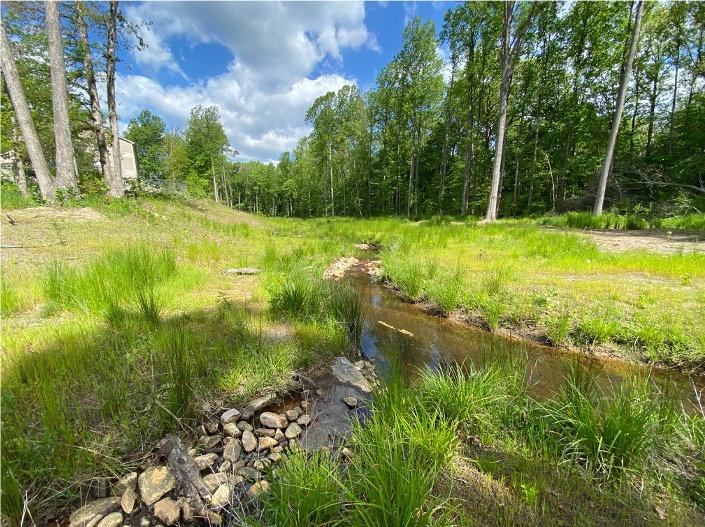
According to the CFPF Grant Manual, “’nature-based solution’ means an approach that reduces the impacts of flood and storm events through the use of environmental processes and natural systems. A nature-based solution may provide additional benefits beyond flood control, including recreational opportunities and improved water quality. This includes a project that reduces these impacts by protecting, restoring, or emulating natural features.” Nature-based infrastructure is a growing term that includes concepts of conservation, land acquisition, and buyouts to protect or restore natural areas, especially along coastlines, floodplains, and low-lying areas. Nature-based infrastructure can also include extensive design, retrofit, or conversion of existing systems, such as green infrastructure, dam removal, stream and floodplain restoration, and constructed wetlands. Finally, it can also include enhancements to existing systems, such as beneficial reuse of dredged material to raise marsh elevations, establishing oyster reefs, submerged aquatic vegetation, and living shorelines. There are a wide variety of NBI applications for both coastal and inland areas that municipalities can capitalize on to help advance resiliency efforts.
Positioning for What’s Next
Long-term sustainability depends on resilient infrastructure, and successful resilience planning requires an integrated approach. While the future of federal investment in resilience projects may be uncertain, the state is providing many tools and resources for Virginia’s municipalities to both plan for and implement projects to mitigate flood risk. Now is a great time to leverage these efforts and align your municipal goals to position for flood resilience.
For dedicated support with your next resiliency-based project, reach out to Aislinn Creel, Senior Resiliency Engineer at aislinn.creel@timmons.com.