Across the U.S. energy market, demand is rising faster than available supply. PJM is feeling that pressure in a major way, especially as data center growth accelerates across the East Coast.
PJM has taken proactive steps to address these pressures, including updates to its generation interconnection process, efforts to move projects through the queue, and the development of an Expedited Interconnection Track for certain large generation projects, all of which have proven successful in expediting new energy projects.
However, even with those changes, developers still face a process that is increasingly competitive, costly, and hard to predict due to shifting pressures in the broader energy environment.
Before entering the queue, developers need to make early decisions about site selection, project size, timing, cost exposure, and study risk. Those choices can shape whether a project moves forward, stalls, or becomes financially infeasible.
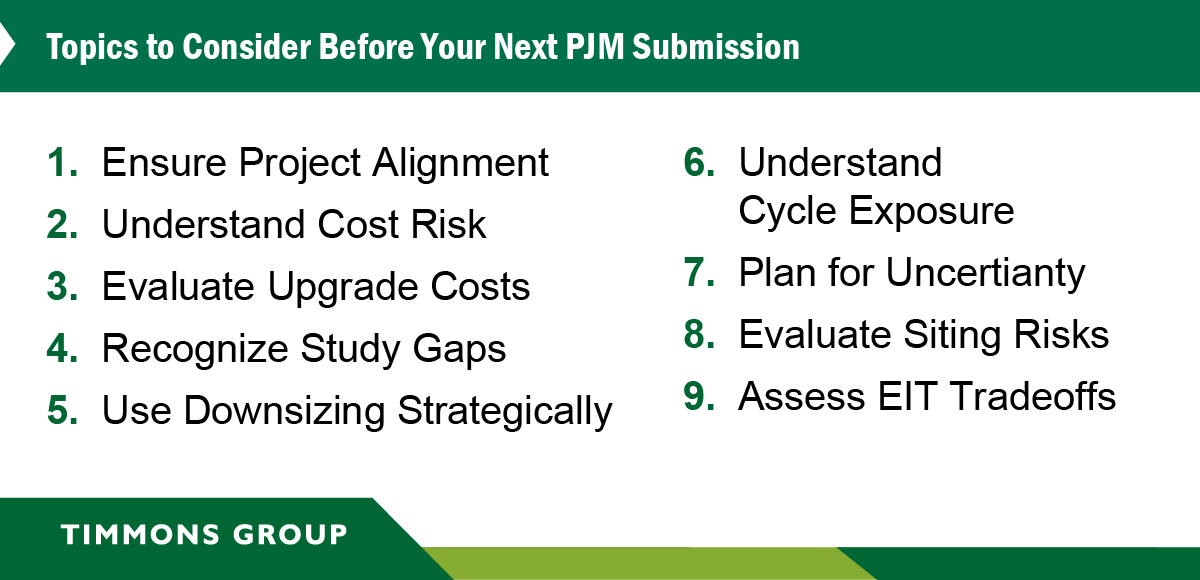
This article covers nine topics developers should discuss with a trusted project partner before their next PJM submission. In our current rapidly changing energy environment, exploring these topics in detail ahead of time can help reduce risk, improve planning, and support better decision-making surrounding project viability.
9 Topics for PJM Process Applicants to Consider Before Their Next Submission
Across the United States, demand for energy, both in current and in projected load, is far outpacing available supply.
This trend is hitting PJM—the regional transmission organization (RTO) that managed the grid for more than 65 million people along the East Coast—particularly hard, as it sits at the center of an evolving data center and advanced manufacturing market that has led to a surge in energy demand and interconnection requests.
Despite PJM taking proactive steps to respond to these issues, developers need to plan carefully to ensure projects remain viable in a rapidly evolving marketplace.
In a space where early decisions around site selection, project sizing, timing, and cost risk can have a major effect on whether a project moves forward, it’s important to have in-depth discussions on several key topics early in the project lifecycle to reduce the risk of disruption and hurdles later in the process.
1. Developers should ensure project alignment before submission.
Before entering the PJM process, developers should make sure their project team has the information needed to create a complete and accurate generation interconnection request. This includes early decisions around project size, point of interconnection, nearby equipment ratings, and required application materials. If a developer already has preferred equipment, procured components, or specific design assumptions, those details should be shared early. Without that alignment, the team may need to revise the concept later, which can add time and create avoidable rework.
2. Cost risk is a central concern for applicants.
Cost risk is one of the most important topics for PJM applicants to understand before entering the queue. Developers should know what deposits are required, what additional money or security may be needed later, and how much capital may be at risk at each step. In general, less money is at risk earlier in the process than later in the study cycle, making proactivity a priority in ensuring project success. Having a clear view of phased financial exposure can help developers make better go/no-go decisions as study results come in.
3. Network upgrade costs are a common dealbreaker.
Network upgrade costs can have a direct impact on whether a project remains viable. With so many projects seeking to interconnect to PJM’s system, applicants may face significant upgrade assignments, including costs tied to higher-voltage facilities across multiple states. These upgrades have gotten in the magnitude of billions for some projects, requiring hundreds of millions of dollars just to continue the study process within PJM. Developers should evaluate likely system constraints before entering the queue and continue reassessing risk as PJM study results are released. A project that looks encouraging at the site level may still face cost barriers once cycle network impacts are studied.
4. Generation and load study processes may lead to disconnects in study conditions.
PJM’s generation interconnection process and load application process are currently handled separately, which can create disconnects in study conditions. New load growth, including large data center demand, may not be reflected in a generation interconnection study until a later cycle. That means a project sited near expected future load may not see that benefit reflected in the study assumptions used for its cycle. Developers should understand this timing gap when evaluating where and how to position new generation projects.
5. Downsizing is a major strategic lever, but only when used effectively.
Downsizing can be a useful tool in PJM’s interconnection study process, especially during Decision Point I, due to the flexibility allowed at this point in the process (up to 100% downsizing allowed penalty free). Because network upgrade cost allocation can be tied to a project’s megawatt impact on overloaded infrastructure (such as a line or transformer), a strategic reduction in size may help reduce or avoid certain cost assignments. However, developers should not treat downsizing as a cure-all. Oversizing at the start can still create major readiness deposit obligations before the project has a chance to reduce its size later.
6. The cycle process changes how cost exposure works.
PJM’s cycle process changes how developers should think about cost exposure. Under the prior serial process, projects could often focus more narrowly on their individual impact and whether they were first to cause an overload. Under the revised cycle process, the aggregate impact of all the projects in the full cycle matters. Even if one project’s individual impact appears limited, it may still face cost exposure if the cycle as a whole contributes enough of an overload impact to require network upgrade assignments, meaning top contributors could still be at risk of sharing in network upgrade costs. This requires projects to closely monitor upgrades identified in their Phase I study where the generator is a “potential aggregate contributor” as this could significantly adjust the costs assigned to the project in the next phase of the study process.
7. Timing is uncertain, even when schedules are published, so flexibility is key.
PJM publishes cycle study schedules, but those dates are not fixed. Current cycles may depend on prior cycles moving forward, which can create a waterfall effect in project timing. Although PJM does its best to meet study deadlines, delays can occur due to unforeseen circumstances such as retool studies after Interconnection Agreements are executed to update allocation among remaining projects. For example, Transition Cycle 1 (TC1) required two retooled studies after the scheduled Phase III study was completed. This uncertainty matters when financing, in-service dates, or commercial operation dates are tied to a specific schedule. Developers should build flexibility into their planning rather than assuming published study dates will hold.
8. Developers should look beyond PJM technical feasibility during the siting phase.
Technical feasibility within PJM is only one part of project viability. Developers should also consider prior projects near the same point of interconnection, why earlier projects may have withdrawn, and whether local conditions could affect permitting or public support. County-level sentiment toward solar, storage, natural gas, or other fuel types can shape the path forward. Understanding those local factors early can help developers avoid spending heavily on a project that may face non-technical barriers later.
9. The Expedited Interconnection Track (EIT) is a high-risk, high-reward approach for large generators.
The Expedited Interconnection Track, expected to go live on July 31, 2026 pending FERC approval, may offer a faster path for certain large projects, but it also carries meaningful financial risk for project stakeholders. The process is expected to be competitive, with only 10 projects allowed to progress to the first year, and will require significant upfront costs for applicants. Projects may need to meet aggressive commercial operation timelines while also fully funding assigned network upgrades. Developers considering EIT should weigh the potential speed of the process against the cost, schedule, and viability risks that may come with it.
PJM Interconnection Strategy Needs to Start Before the Queue Opens
Developers can better position PJM projects for success by aligning strategy for their interconnection strategy well before the queue opens. Early planning should include project sizing, point-of-interconnection review, equipment assumptions, local siting considerations, and a realistic view of potential network upgrade exposure.
The PJM process is not only an application exercise. It is a series of technical, financial, and timing decisions that can affect whether a project moves forward. Developers who understand those issues early are better prepared to respond when study results, cost allocations, or schedule changes affect the project.
PJM applicants should approach interconnection as a development strategy, not just a required process. Early due diligence, realistic cost planning, flexible schedules, and informed site selection can help developers reduce risk before significant capital is committed.
As demand growth, generation needs, and PJM study processes continue to evolve, the strongest projects will be those planned with the full process in mind from the beginning.